
Why Most Law Firms Stay Small — and How Elite Lawyer Business Strategies Change That
Elite lawyer business strategies are the operational, marketing, and leadership frameworks that separate high-growth law firms from those that stay stuck at the shingle stage.
Here’s a quick snapshot of what actually moves the needle:
- Shift your mindset — from lawyer who owns a firm to business owner who practices law
- Build predictable revenue — through tiered memberships, retainer structures, and value-based pricing
- Establish authority — via peer-reviewed directories, PR, thought leadership, and premium media
- Develop relationships systematically — consistent networking, client stewardship, and referral pipelines
- Hire and delegate strategically — use the “finders, minders, grinders” framework to scale without burning out
- Track the right KPIs — Monthly Recurring Revenue, Collection Rate, Average Case Value, and Client Acquisition Cost
The legal market is brutally competitive. There are roughly 1.3 million lawyers in the U.S. competing for attention in a $400 billion industry. Most firms stay small not because their lawyers lack skill — but because no one ever taught them how to run and grow a business.
That’s the real gap. As one business development expert put it after interviewing more than sixty successful rainmakers worldwide: business development is a learnable craft rooted in habits and mindsets, not innate talent or lucky breaks.
This guide is for ambitious law firm owners who are done guessing. Whether you’re trying to build predictable revenue, attract high-value clients, or expand into new markets, the strategies below are drawn from what elite firms are actually doing in 2026 — not theory.
Shifting from Practitioner to CEO: Elite Lawyer Business Strategies for Scaling

To move beyond a solo shingle, we must embrace a fundamental truth: the skills that make you a great lawyer are rarely the same skills that make you a great CEO. Scaling requires radical self-awareness. One of the most effective frameworks for understanding your role in a growing firm is the “Finders, Minders, and Grinders” model.
- Finders are the rainmakers who bring in the business.
- Minders manage the clients and the team to ensure the work is done well.
- Grinders are the technical experts who do the heavy lifting of legal research and drafting.
In the early days, you are likely all three. But to scale, you must identify your gaps. If you are a brilliant “Grinder” but hate networking, you need a “Finder.” If you are a visionary leader but your office is a mess of unfiled motions, you need a “Minder.”
Decisive leadership is the hallmark of elite lawyer business strategies. This includes the difficult but necessary philosophy of “firing fast.” Toxic employees or partners act like a cancer within a firm’s culture; excising them early protects the healthy tissue of your organization. This operational foresight allows you to build systems that function independently of your presence. Through Strategic Planning, we help owners move from “firefighting” daily crises to executing a long-term vision.
The 2026 legal market rewards those who treat their practice as a scalable entity. This means implementing Business Coaching to refine your leadership style, moving away from micromanagement and toward high-level oversight.
Implementing Membership Tiers as Elite Lawyer Business Strategies
One of the most innovative ways to stabilize a firm’s finances is through flat-fee membership models. Traditional hourly billing often creates a “feast or famine” cycle. By offering tiered plans, you turn legal services into predictable, recurring revenue.
For example, current Elite Legal Strategy service models often include:
- Essentials Plan: Typically around $299/month, offering a set number of monthly advisory calls for small businesses.
- Growth Tier: Around $449/month, providing more frequent access and document reviews.
- Executive Customization: Starting at $649/month and scaling upward for comprehensive “Outside General Counsel” services.
These models position your firm as a vested partner in the client’s success rather than just a vendor they call when things go wrong. It builds a “moat” around your client base, making it much harder for competitors to pick them off.
Leveraging Premium Directories and Awards for Elite Lawyer Business Strategies
In an era where potential clients are bombarded with choices, peer-validated recognition acts as a powerful shortcut for trust. Being listed in premium directories like Best Lawyers, Elite Lawyer, or Haute Lawyer provides the social proof necessary to attract high-net-worth (HNW) individuals.
These recognitions are not just vanity projects; they are based on rigorous peer reviews and independent research. For instance, having attorneys recognized in specialized areas like Commercial Litigation or Product Liability signals to the market that you operate at the top 1% of your field.
Effective Elite Lawyer Management branding involves more than just putting a badge on your website. It’s about leveraging that authority across all channels—social media, press releases, and media appearances—to build a cohesive narrative of excellence. In 2026, the standard for recognition is high; simply “being a lawyer” isn’t enough. You must be a recognized authority.
Innovative Revenue Models and High-Value Pricing Strategies
Beyond memberships, elite firms are rethinking how they price every aspect of their work. The goal is to move away from the “billable hour” trap where your income is strictly capped by the number of hours you can physically work.
Consider these high-value pricing strategies:
- Volume-Based Hourly Rates: If a client commits to a larger retainer (e.g., $10,000+), the hourly rate might drop from $500 to $400. This incentivizes larger commitments and improves cash flow.
- Fixed-Fee Dispute Resolution: Offering mediation services at a flat rate—such as $3,000 for a half-day or $6,000 for a full day—provides clients with cost certainty while allowing the firm to maximize profit through efficiency.
- Co-Mediation: Using two experienced attorneys to resolve complex matters can often lead to faster resolutions and higher client satisfaction, justifying a premium fee.
Traditional Hourly vs. Tiered Membership ROI
| Metric | Traditional Hourly Billing | Tiered Membership Model |
|---|---|---|
| Revenue Predictability | Low (fluctuates with case load) | High (Monthly Recurring Revenue) |
| Client Relationship | Transactional/Reactive | Partnership/Proactive |
| Administrative Overhead | High (constant invoicing/collections) | Low (automated monthly payments) |
| Scalability | Limited by staff hours | High (leverages standardized services) |
By adopting value-based pricing, you align your firm’s financial interests with the client’s outcomes. When you solve a $1 million problem in five hours, the client shouldn’t just pay for five hours of time; they should pay for the $1 million solution.
Building Authority Through Reputation and Multi-Channel Marketing
Your reputation is your most valuable asset, but in the digital age, it is also your most vulnerable. Elite lawyer business strategies must include proactive reputation management. This isn’t just about deleting negative reviews; it’s about controlling the narrative.
Reputation risks and mitigation strategies involve:
- Monitoring Online Mentions: Using tools to track what is being said about your firm in real-time.
- Professional Responses: Never getting into “comment wars.” A calm, professional response to a negative review often impresses potential clients more than a five-star rating does.
- Content Creation: Publishing high-quality blogs and whitepapers that showcase your knowledge.
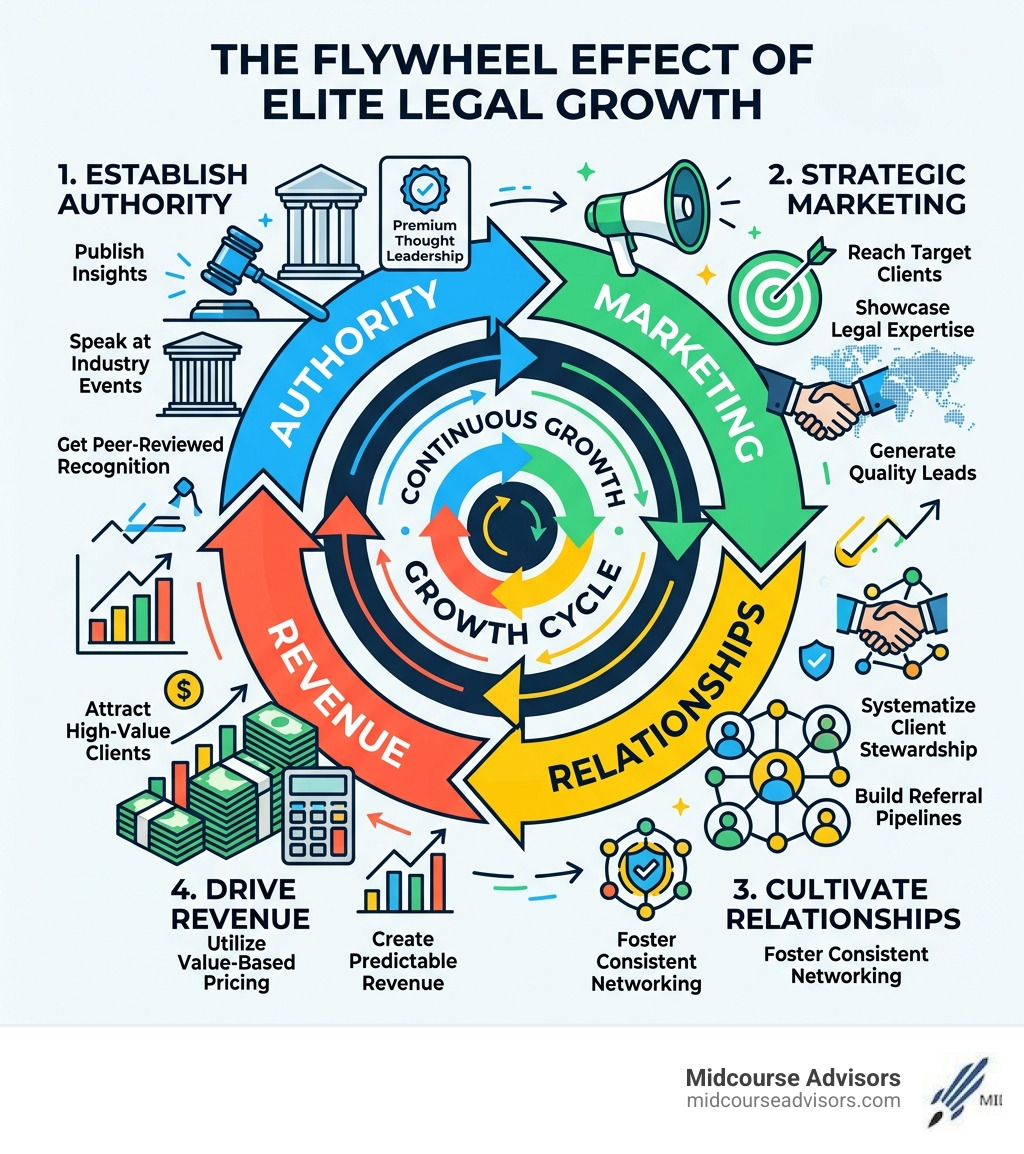
To attract HNW clients, generic marketing won’t work. You need 10 Elite Marketing Techniques that create a “flywheel effect.” This includes luxury media placements (like editorial profiles in high-end lifestyle magazines), targeted SEO for high-intent keywords, and thought leadership through speaking engagements at industry-specific conferences.
By appearing on news outlets or in prestigious publications, you gain “earned media” that carries far more weight than a paid advertisement. This multi-channel approach ensures that when a high-value prospect searches for a solution, your firm appears as the inevitable choice.
The Rainmaker’s Playbook: Relationship-Driven Business Development
Despite the rise of digital marketing, the legal industry remains a “people business.” The most successful rainmakers don’t rely on “the hard sell.” Instead, they practice radical generosity and authenticity.
Leading rainmakers view relationship-building as a daily discipline. They stay in touch with clients between matters, sending relevant articles, checking in on personal milestones, and making valuable introductions. This “stewardship” transforms you from a vendor into a trusted advisor.
Elite leaders also act as “Multipliers.” A Multiplier is a leader who attracts talent and liberates them to do their best work. They invest in human capital and create an environment where employees feel empowered to make decisions. This is a core component of Executive Coaching. By being a Multiplier, you don’t just grow your firm; you grow the people within it, which in turn fuels sustainable expansion.
Don’t just network to get; network to give. Introduce a client to a great CPA. Refer a case that isn’t a fit for you to a trusted colleague. This culture of generosity eventually creates a referral pipeline that never runs dry.
Operational Excellence: Systems That Enable Scalable Expansion
One of the biggest bottlenecks in law firm growth is the “Intake Trap.” Many firms treat intake as a clerical task. Elite firms treat it as a specialized sales role. There is a massive difference between intake (answering the phone and taking notes) and sales (closing the deal and signing the case).
To optimize this, we recommend the TEPPT framework:
- Tone: Use a multi-tonal, engaging voice that builds immediate rapport.
- Empathy: Balance caring for the client’s story with the professional distance needed to guide them toward a solution.
- Pace: Control the speed of the conversation. Use “pattern interrupts” to keep the prospect focused on the next steps.
- Pitch: Tailor your solution to the client’s specific “urgency point.”
- Transition: Use interjections—saying the person’s name with a slight lift—to guide the conversation without being rude.
Scaling also requires a shift in how you delegate. If the best person at every job in your office—from filing to marketing—is you, then you have “grossly under-hired.” You must delegate authority, not just tasks. This allows your team to optimize processes while you focus on high-level strategy.
At Midcourse Advisors, we emphasize KPI tracking to ensure these systems are working. If you aren’t measuring your conversion rates and cost per acquisition, you are flying blind. Data-driven leadership allows you to see where the “leaks” are in your bucket so you can plug them before pouring in more marketing dollars.
Frequently Asked Questions about Elite Legal Growth
How often should I update my law firm business plan?
You should conduct a major review of your business plan at least once a year. However, immediate updates are necessary if you experience a sudden surge in growth, a major market shift (like the introduction of new AI regulations in 2026), or if you decide to pivot your practice area. A business plan isn’t a static document; it’s a “living” strategy that should guide your daily decisions.
What are the most important KPIs for an elite law firm?
While every firm is different, the “Big Four” for elite growth are:
- Monthly Recurring Revenue (MRR): The bedrock of predictable growth.
- Collection Rate: Aim for at least 90%. If you’re doing the work but not getting paid, your business model is broken.
- Average Case Value: Are you taking on high-value work, or just “busy work”?
- Client Acquisition Cost (CAC): How much does it cost to bring in a new client versus the revenue they generate?
How do I separate intake from sales to increase conversion?
Start by hiring for “Sales DNA” rather than just legal experience. A former insurance agent or mortgage closer often makes a better “closer” than a paralegal. Implement public leaderboards to foster healthy competition and use CRM workflows to ensure no lead ever falls through the cracks. By separating these roles, your intake team focuses on being friendly and helpful, while your sales team focuses on signing the contract.
Conclusion
Building an elite law practice is a marathon, not a sprint. It requires a relentless focus on operational excellence, innovative revenue models, and authoritative branding. But you don’t have to do it alone.
At Midcourse Advisors, we provide the Services and coaching necessary to help law firm owners transition from practitioners to CEOs. Our clients don’t just grow; they out-earn their peers by an average of 8X through our vested partnership and collaborative strategies.
If you’re ready to move beyond “just a shingle” and build a firm that offers personal, professional, and financial freedom, it’s time to implement these elite lawyer business strategies. Let’s raise the bar for your practice together.