
Why Law Firms Keep Losing Revenue — And What to Do About It
To increase billable hours, focus on these core actions:
- Track time in real time — don’t wait until the end of the day
- Delegate non-billable tasks to support staff or virtual assistants
- Run regular time audits to spot inefficiencies and revenue leaks
- Automate repetitive admin work to free up capacity for client work
- Define clear billing policies so your whole team knows what counts
- Minimize distractions and batch similar tasks together
- Use time-tracking software that syncs directly with your billing system
Here’s a painful truth most law firm owners already know but rarely say out loud: you’re probably leaving serious money on the table every single week.
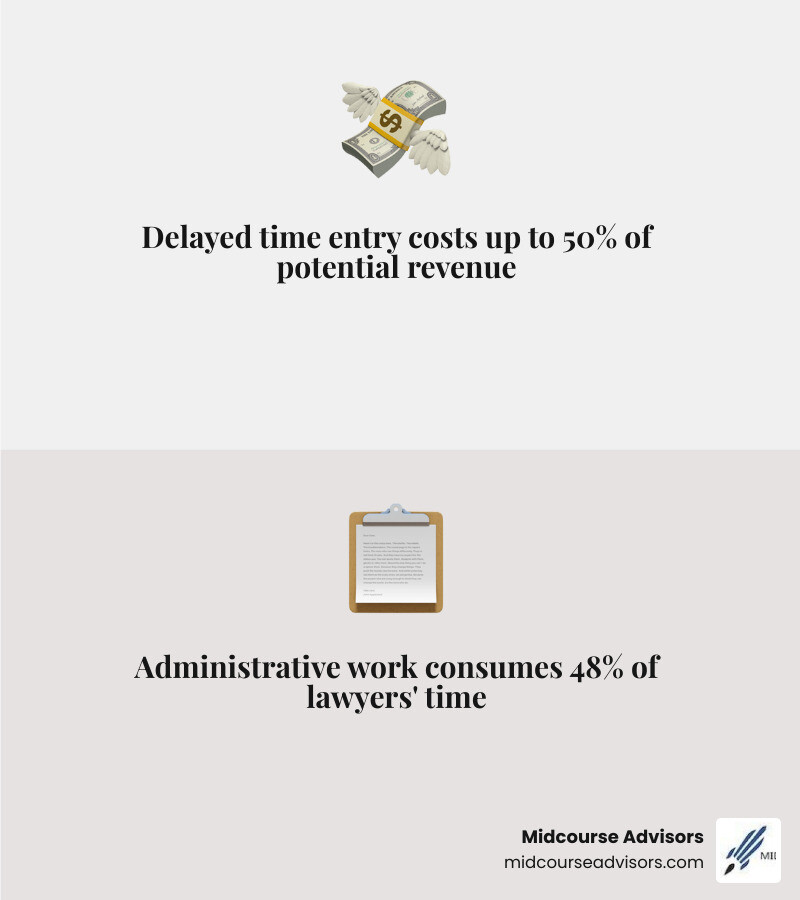
The average lawyer bills only around 1,693 hours per year — well short of the 1,800 to 2,200 hours most firms actually require. Meanwhile, administrative work alone eats up roughly 48% of a lawyer’s time. That’s nearly half your workday going to tasks that don’t generate a single dollar in revenue.
And it gets worse when you delay recording your time. Waiting until the end of the day to log hours can cost you more than 10% of your billable time. Push that to the next day, and you could lose up to 50% of potential revenue — not from working less, but simply from forgetting.
This isn’t a time problem. It’s a systems and habits problem.
If you’re running a growing law firm and you’re serious about predictable revenue, the good news is that most of this lost income is completely recoverable — without working longer hours or burning out your team.
Defining the Billable Hour: What Counts and What Doesn’t
To increase billable hours, we first have to agree on what a billable hour actually is. In the legal world, time is our most precious inventory, yet many professionals struggle to define the boundaries of what a client should pay for.
Generally, a billable hour is any time spent on a task that directly advances a client’s interests. In 2026, the industry standard remains the 6-minute increment (or one-tenth of an hour). This means if you spend four minutes on a client email, you bill 0.1 hours. If you spend seven minutes, you bill 0.2.
But it’s not just about the math; it’s about the nature of the work. For a task to be billable, it should typically meet these criteria:
- It consists of substantive legal work.
- It is allocable to a specific client or matter.
- It is a task the client has consented to or requested.
- It aligns with industry standards for that specific type of case.
Common billable activities include legal research, drafting pleadings, attending depositions, and communicating with opposing counsel.
Identifying Non-Billable Time Leaks
If you feel like you’re working 10-hour days but only billing five, you’re likely suffering from “non-billable creep.” Research shows that administrative work consumes about 48% of a lawyer’s time. These are the “leaks” in your revenue bucket.
Non-billable time usually includes:
- Internal Firm Management: Responding to firm-wide memos or attending internal resource allocation meetings.
- Business Development: Networking, writing blog posts, or attending mixers.
- Administrative Overhead: Filing, basic data entry, and fixing the office printer (we’ve all been there).
- Training and CLEs: While necessary for your license, these are rarely billed to a client.
While these tasks are necessary to keep the lights on, they shouldn’t be the primary focus of a high-earning attorney. Identifying where these leaks occur is the first step toward plugging them.
| Billable Tasks | Non-Billable Tasks |
|---|---|
| Legal Research & Analysis | Internal Staff Meetings |
| Drafting & Reviewing Contracts | Firm Marketing & Networking |
| Client Consultations | Continuing Legal Education (CLE) |
| Court Appearances | Administrative Filing & Scanning |
| Case-Specific Strategy Sessions | General Office Management |
7 Proven Strategies to increase billable hours Without Burnout
Increasing revenue doesn’t have to mean sacrificing your sanity. In fact, many of the best ways to increase billable hours actually involve working less on the things that don’t matter.

At Midcourse Advisors, we often see that the difference between a struggling firm and one that thrives is the implementation of Strategic Planning. Here are seven tips to get you started:
- Track as You Go: Don’t wait. The moment you finish a task, log it.
- Use Detailed Descriptions: Clients are less likely to dispute a bill that says “Researched jurisdictional requirements for motion to dismiss” than one that just says “Legal research.”
- Perform Time Audits: Look back at your last month. Where did the “lost” hours go? 49% of professionals have never done a time audit—don’t be one of them.
- Batch Your Tasks: Group similar activities together. Context switching can waste up to 40% of your productive time.
- Set Daily Targets: Aim for a specific number of billable units each day to keep yourself on track.
- Minimize Distractions: Turn off non-essential notifications. Every “quick check” of your phone is a 6-minute increment you’ll never get back.
- Follow 7 tips to increase billable hours: Use tools that help you visualize your day and identify where time is slipping away.
Use Contemporaneous Entry to increase billable hours
We cannot stress this enough: contemporaneous time entry is the “key to the castle.”
When you wait until the end of the day or—heaven forbid—the end of the week to enter your time, you are relying on a “memory assistant” that is notoriously unreliable. Statistics show that waiting until the end of the day can lead to a 10% loss in billable time. If you wait until the next day, that loss can jump to 50% of potential revenue.
Imagine working a full hour on a complex research memo but only remembering 40 minutes of it because you were interrupted by three phone calls. You just gave away 20 minutes of your life for free. Real-time logging ensures that every minute worked is a minute earned.
Delegate Administrative Tasks to increase billable hours
You are a highly trained legal professional. Your time is worth hundreds of dollars an hour. So why are you spending 30 minutes trying to format a PowerPoint or scheduling a lunch meeting?
To truly increase billable hours, you must offload non-billable “shallow work.” This might mean:
- Hiring a virtual assistant for scheduling and basic research.
- Empowering paralegals and support staff to handle document assembly and initial drafts.
- Outsourcing your bookkeeping and billing processes.
By delegating these tasks, you free up your capacity for “high-value work”—the kind of work that only you can do and that clients are happy to pay for.
Leveraging Technology and Automation for Efficiency
In 2026, technology is no longer optional; it is the primary driver of firm profitability. According to recent industry insights, up to 74% of traditionally billable legal tasks can be automated.
If you want to How to Increase Billable Hours: 10 Best Practices, you need to look at your “tech stack.” Modern legal CRMs and automated time-tracking tools can capture time in the background while you work. They sync with your calendar, your email, and your document management system to ensure nothing falls through the cracks.
Automation doesn’t just save time; it improves accuracy. When your software automatically rounds your 7-minute call to the next 0.1 increment and suggests a description based on the document you were editing, you eliminate the friction that leads to procrastination.
Preventing Billing Disputes with Data
One of the biggest fears lawyers have when trying to increase billable hours is client pushback. “Will they think I’m overcharging?”
The best defense against a billing dispute is a mountain of data. When you provide transparent, detailed audit trails, you build client trust. Detailed time descriptions—those that explain the “why” and “how” of the work—show the value you provided.
Establish firm-wide standards for time entry. When every associate and paralegal follows the same policy, your invoices look professional and consistent. This transparency makes it much easier for clients to say “yes” to your bills.
The Psychology of Timekeeping: Shifting Your Mindset
Increasing your billable time isn’t just about software and stopwatches; it’s about what’s happening between your ears. Many professionals view timekeeping as a “drag” or a “necessary evil.”
To succeed, you need to adopt Key Strategies to Change Your Mindset about Billable Time. You have to stop seeing yourself as a “billing partner” (someone who decides what the work is worth) and start seeing yourself as a “timekeeper” (someone who accurately records what happened).
Many attorneys suffer from imposter syndrome, which leads to “confusion-cutting”—rounding down their time because they feel they took “too long” on a task. This is a mistake. Your job is to record the time; the billing partner’s job is to decide the final invoice.
Try to find the “dopamine hits” in the process. There is a profound sense of achievement in looking at a completed, accurate timesheet at 5:00 PM and knowing that your work is done for the day. This shift from fear-based motivation to self-determination is what prevents burnout.
Frequently Asked Questions about Billable Hours
What are realistic billable hour targets for professionals?
While every firm is different, most “Big Law” firms set targets between 1,800 and 2,200 billable hours per year. For smaller firms and solos, a realistic goal is often closer to 1,500 to 1,700 hours, assuming you are also handling firm management.
In the agency world, the target is usually expressed as a utilization rate. Most agencies aim for 75-80% billable time. If you’re billing more than 85%, you’re at high risk for burnout. If you’re billing less than 60%, you’re likely leaking revenue.
How do you accurately calculate billable hours?
The standard formula is: (Time Spent in Minutes / 60) x Hourly Rate. However, since we bill in tenths of an hour, you first convert your minutes to decimals:
- 1-6 mins = 0.1
- 7-12 mins = 0.2
- 13-18 mins = 0.3 …and so on.
It’s also helpful to distinguish between “billable hours” (what the client pays for) and “delivery hours” (the total time you spent working). Calculating your billable efficiency (Billable Hours / Total Hours) gives you a clear picture of your productivity.
What are the ethical considerations for increasing billable time?
Ethics are paramount. You should never engage in:
- Block Billing: Grouping multiple unrelated tasks into one large time entry (clients hate this, and many courts forbid it).
- Double Billing: Charging two different clients for the same hour of work (e.g., doing research for Client A while traveling for Client B).
- Padding: Inflating the time spent on a task.
The goal is to increase billable hours by capturing actual work that was previously lost, not by inventing work that didn’t happen. Authenticity and transparency are your best friends here.
Conclusion
At the end of the day, your law firm is a business. To grow, you need to be as diligent about your revenue as you are about your legal arguments.
At Midcourse Advisors, we specialize in helping law firm owners navigate these challenges. We provide the coaching and Services needed for personal, professional, and financial growth. Our clients consistently out-earn their peers by 8X because we focus on proven, collaborative strategies and a vested partnership in your success.
If you’re ready to stop leaking revenue and start maximizing your firm’s potential, it’s time to take a hard look at your systems. You don’t need to work more hours—you just need to make the hours you already work count.
Let’s get started on your journey toward a more profitable, less stressful practice today. Reach out to us to learn more about how we can help you About Us.